Highsfield for Agency Pitch Concepts: Writing a Clear Video Brief
 Yolanda Carreir…
0
3
10.13 08:05
| 사이트 이름 | Highsfield for Agency Pitch Concepts: Writing a Clear Video Brief |
|---|---|
| 사이트 주소 |

|
| 가입코드 | |
| 보증금 |
1천만원

|
| 게임종류 | |
| 특장점 |
상세 내용
There is a difference between imagining a scene and explaining how that scene should unfold. Highsfield gives small creative agencies a place to study that difference through Seedance 2.5 workflow guidance and public examples. A hypothetical agency pitch project makes the question concrete: the brief should make a proposed campaign direction easy to discuss. A visible change should connect its opening and closing states. Those choices help keep an experiment grounded when an attractive first result invites premature approval.
Highsfield’s public pages connect scene prompts, supported image inputs, model settings and review of completed results. Seedance 2.5 is the workflow discussed here, but current availability and accepted inputs should be checked in the generator. The public examples are references with their own context and model attribution. A gallery image is not a specification sheet; use it to study a creative decision rather than assume every visible technique is available in every model.
Define the Job Before Describing the Look
Consider a fictional assignment for small creative agencies. Its purpose is to make a proposed campaign direction easy to discuss. The setting is a clean tabletop with an unbranded product placeholder, and the required visual detail is the object proportions and reserved graphic space. Give the viewer one action to recognize before adding another. Pitch material should help a client decide between directions, not claim a campaign has already succeeded. Label the study as a concept and keep unsupported performance figures or invented customer reactions out of the presentation.
Limit the brief to a subject, a setting and a visible event before deciding on style. Here, a clean tabletop with an unbranded product placeholder establishes the environment and the camera reveals the placeholder from a slightly different angle supplies the event. The requirement is that the object proportions and reserved graphic space stays recognizable. That combination gives the scene a practical structure. Additional direction should explain lighting or framing, without changing the assignment into several different scenes competing for a small amount of screen time.
Translate the Idea Into a Seedance 2.5 Prompt
A proposed scene prompt could read: "Setting: a clean tabletop with an unbranded product placeholder. Action: The camera reveals the placeholder from a slightly different angle. Camera: a slow horizontal move. Preserve the object proportions and reserved graphic space. Keep the background stable and end with the subject still recognizable." This is an original planning example, not a tested generation record. Select only input and output options the current model actually supports.
Separate subject motion from camera motion in the brief. In this scene, the camera reveals the placeholder from a slightly different angle, while the view uses a slow horizontal move. Those instructions should not quietly become two unrelated actions. State what stays fixed as clearly as what moves. The distinction is particularly useful when a reference image already establishes the object’s appearance but says nothing about how the shot should progress or where it should end.
Distinguish the subject description from the style preference. In a agency pitch study, the object proportions and reserved graphic space is an appearance requirement, while the atmosphere can be adjusted later. Write requirements in concrete terms before choosing optional styling. This helps a revision preserve the useful structure instead of discarding it because the first lighting treatment was not ideal. The prompt then becomes a record of an intention the team can actually review.
Study Published Images and Video Examples
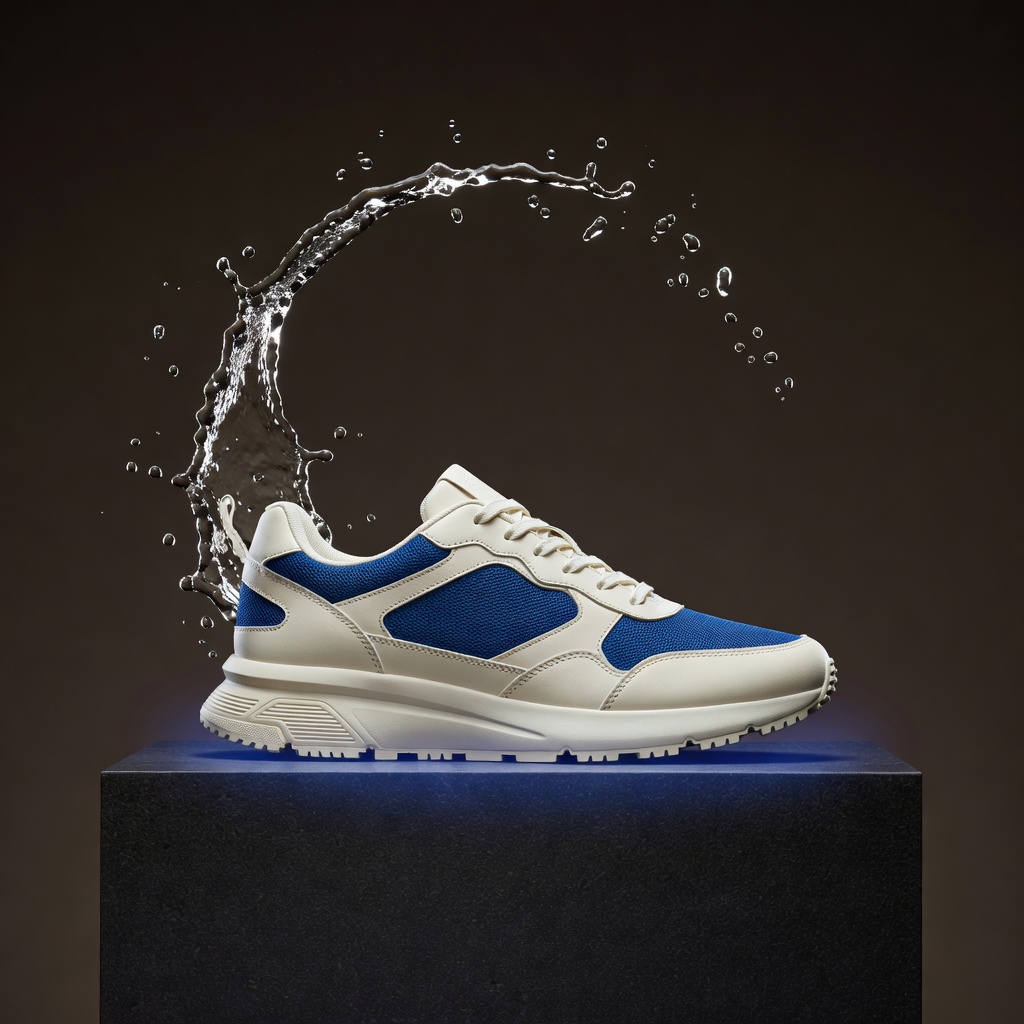
 Published Highsfield visual reference: Blue and white sneaker in a studio splash composition.
The published image shows a blue and white sneaker on a dark display with an arc of water. It is useful for studying a strong silhouette and the balance between product detail and surrounding effects. The reference supplies a composition, not an automatic motion instruction. Use that distinction when planning the proposed scene. This is a reference from the public site, not a newly generated result or proof of Seedance 2.5 performance.
Published city-street video example from Highsfield. Open the published video example.
The video poster shows a person seen from behind on a city street. Open the clip to study subject placement, travel direction and the role of background perspective, then judge the moving result rather than inferring it from the poster. Its use here is as a visual reference; this article does not attribute the clip to Seedance 2.5. Inspect the full action before applying a similar framing decision. The proposed project remains a separate, hypothetical exercise.
Review the Action and Required Details
For this particular concept, compare the concept with the approved campaign brief. Reject the draft if the product placeholder gains a client logo without approval. That is a visible requirement rather than a general preference for a polished look. If the mismatch appears in only part of the clip, identify that moment before changing the brief. An acceptable opening frame does not excuse a subject or environment that becomes inaccurate during the intended action.
Review the clip at normal speed before examining individual frames. The first pass asks whether the action is understandable; the second looks for instability in the object proportions and reserved graphic space. Frame inspection often catches details a smooth playback hides. Compare the opening, a middle moment and the ending, then examine any transition that looks wrong. Do not let an attractive thumbnail stand in for a review of the actual moving result.
Approve the brief before approving a generated result. A teammate should be able to identify the main action, the required detail and the destination of the clip. A clear assignment makes the first review more specific. If the proposed scene quietly asks for several conflicting events, fix that problem in the writing stage. This is a smaller and more informative intervention than repeatedly requesting new outputs from the same unclear instructions.
Take the Highsfield Draft Into the Final Edit
Keep the request settings beside the prompt when evaluating a result. Duration, aspect ratio, resolution and audio options can affect the assignment, and their available values depend on the selected workflow. Let the current interface define the selectable options. If you change the destination of the clip, revisit the framing before generating another version. A crop that removes the key action is a production problem even when the file itself downloads correctly.
A handoff needs more than a ai video generator file. State the destination, intended message, source permissions and any detail that must stay visible. In this exercise, place the approved scene brief beside the selected draft before editing the final caption. A clear delivery note helps the next editor preserve the action. If the published asset is an illustration or concept, keep that status understandable. Do not turn a planning study into an apparent product test, customer testimonial or record of a real event.

A useful next step is to write the scene in one plain paragraph and decide what would make it unacceptable. For this project, that includes the moment when the product placeholder gains a client logo without approval. Highsfield and its Seedance 2.5 workflow can support the exploration, but the creator still needs to supply a clear purpose and judge the result. Use the observable result as the basis for the decision, then preserve the approved version with its prompt and source context.
Comments
-
11.05
 공지
field pile load testing
-
11.05
공지
Chutný kynutý knedlík ze sušeného droždí: Případová studie
-
11.05
공지
Budgeting for Emergency Plumbing in Moss Point, Mississippi: What to Expect
-
11.05
공지
You Need To Be A Solicitor?
-
11.05
공지
винтовые сваи в Екатеринбурге
-
11.05
공지
Edad Pulmonar: Ymmärrys ja merkitys keuhkojen terveydelle
-
11.05
공지
Scottsville's Forestry Services: A Commitment to Sustainable Forest Management